


Crumar Spirit


Analog Keyboard Synthesizer by Bob Moog, Tom Rhea & Jim Scott


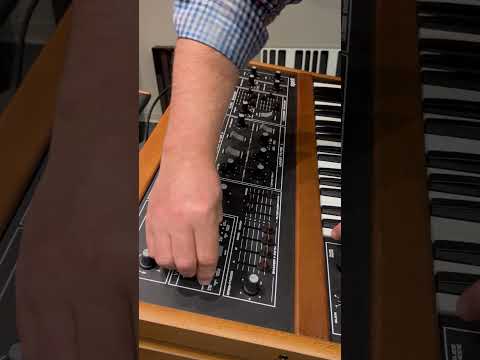


The idea of putting the Crumar Spirit back into production is not recent history. It was 2010 when VMConnection, owner of the “Crumar” brand, took its first steps in the world of production and marketing of musical instruments: the first instruments were the Crumar Bassman and the Crumar Baby Grand. Even then, even in the product names (Bassman as a tribute to the various Brassman, Pianoman, Multiman) and Baby Grand (as a tribute to the vintage Crumar Baby grand), the modern Crumar always wanted to maintain a connection to the past. We knew we were carrying the weight of a historic and important brand on our shoulders.
In 2021, we first attempted to forge this link between the historic “Crumar” and the actual company with the release of the “Performer” software, a virtual replica of an iconic string machine produced in the late 70s. A good candidate for a replica or reissue it could certainly be the very famous Crumar DS-2 or the Bit One synthesizer.
Crumar Spirit: THE HISTORY
But the truly iconic vintage instrument produced by the “historic” Crumar was the Spirit synthesizer.
This instrument embodies all the typical characteristics of a legendary synth: it was designed by Bob Moog, the inventor of the Moog Synthesizer, Tom Rhea, electronic music historian and synthesis expert and Jim Scott, former Moog Music engineer, it is extremely rare and exotic, but above all, it’s a good sounding instrument, in line with (and in some respects superior to) the great historic monophonics of the late 70s.
Crumar Spirit, in some ways, can be considered the missing link in Bob Moog’s production and industrial history since his departure from Moog Music in the late 70s, his subsequent consultancy work and first real new synthesizer produced in 2002,
the Voyager: which shares a lot with Spirit.
There isn’t a lot of information concerning the production of the Crumar Spirit in the years 1983 and 1984, another aspect increasing the interest and feeding the myth: we have to imagine a large factory, like it was Crumar in the early 80s with various products in the catalogue, organs, keyboards, accessories, a continuous cycle production of thousands of units per month, all born, designed, conceived in Italy; and then, probably in a small corner of the production area, certainly not in a continuous cycle, there was the production of the Spirit, an instrument created and conceived by an external designer (Bob Moog) who certainly was following the production phases and testing too.
There is no certain information on the quantity actually produced, the most reliable news came from the engineer Luciano Iura (a Crumar designer who at the time worked alongside Bob Moog) before his death: he speaks of 100 units at all.
THE IDEA: CRUMAR AND “MARCHE SYNTH MUSEUM”.
As often happens in both private and professional life, it is the encounters that make the difference.
In this case it was the meeting between the new Crumar and the people of “Marche Synth Museum” that saw the creation and completion of this project. This Italian association is certainly fresh, but it already has considerable theoretical and practical results to its credit. Their research and analysis of historic musical instrument companies in the Marche region have brought to light stories of too-soon forgotten people and instruments, often avant- garde realities, instruments with enormous potential, rarities, and very interesting anecdotes… in short, all that material that is not found on the internet, a sort of “recent” archaeology.
Between the new “Crumar” and the “Marche Synth Museum” there is a great sharing of visions: taking the beauty of the past and trying to re-purpose it today, introducing today’s musicians to the instruments of the 60s, 70s and 80s, sometimes very rare and innovative instruments: Italian history is full of similar examples, also in other fields. The love for Italian vintage synthesizers has therefore gathered a large group of enthusiasts, musicians, repairers, amateurs and even companies. The difference lies in the fact that the “Marche Synth Museum” carries out this research every day for the passion and taste of discovery, while Crumar tries to make this concept concrete in the production and marketing of musical products.
HOW EVERYTHING STARTED.
Let’s be honest, over the years hundreds of people have written to us asking the same question: “but why don’t you do the Spirit again?” We have always answered this question evasively because the project was perhaps too big for us, a company with a strong international presence, certainly prepared in the world of digital electronics but with little experience in the design and creation of completely analogue instruments.
In one of the many meetings with the people of the “Marche Synth Museum” in January 2020, the key topic was, as always, the synthesizers. Here the fateful question pops up… “but why don’t you re-do the Spirit?”.
Compared to the past, however, something had changed: we were no longer alone, we had the possibility of being able to take advantage of a team of people who had already worked on the Museum’s restoration projects, well-prepared people with specific experience. Moreover, we had the possibility to have a couple of original Spirits at our disposal, another fortunate asset given Crumar Spirits are so rare. The project started shortly after, exactly when the world was experiencing the Covid crisis.
WORK IN PROGRESS.
The division of tasks had already been outlined: while the collaborating designers of the Marche Synth Museum concentrated on the reverse engineering of the original instrument, the Crumar company began to think about the industrialization of the product.The principle was simple, make the instrument completely in “pieces”, clone its circuits, rebuild a new prototype, and evaluate its technical feasibility and result. The operation lasted about 6 months, from March 2020 to September 2020.
The first “decision-making” meeting took place in October 2020: on that occasion we tested, stressed, and listened to the prototype and, at the end of the “meeting” we all agreed on the real possibility of putting the instrument back into production and, above all, putting it back into production as it is.
But, this first step, although fundamental, is perhaps 20% of all the work behind this operation. The next step was the industrialization. The original Spirit was released in 1983, a year in which the Italian music industry was already in a state of crisis because its production systems were old and obsolete: to make a comparison, in the same year in which the Spirit was released, Yamaha released the famous DX7. At that time, single-layer electronic boards and connections made with single wires were the production standards in Italy: we certainly did not want to do exactly the same thing in 2023!
“NEW SPIRIT” SPECIFICATIONS: NO COMPROMISES.
This was one of the many questions we asked ourselves and which we immediately answered: we had firm points and absolutely wanted to make an instrument with the least number of compromises possible. This is why the industrialization takes on a very important role in the creation of the “new” Spirit.
In this case, we don’t like the word “clone” or “reissue”: simply Crumar, after 40 years, is putting the Crumar Spirit back into production… but this will be a limited series.
We stood firm on the aesthetics and circuitry being absolutely identical to the original, but this raised some problems since more than one part or component of the instrument was obsolete and needed a philological replacement. Starting from electronics, transistors, integrated circuits, and obsolete potentiometers. Regarding transistors and integrated circuits, we have carried out in-depth research to find the real substitutes, as far as potentiometers and sliders are concerned, we have simply remade them like the originals, in other cases we have even improved parts.
The selection switches, another obsolete and unobtainable product, have been replaced by a modern and more reliable model.
We completely redesigned and remade the moulds for knobs, sliders, modulation wheel and pitch bender, the latter improved with the more “modern” return spring.
A further challenge was the keyboard: the instrument has now been equipped with a modern keyboard, also Made in Italy based on the “bubble contact” system, a definite improvement from the older keyboards based on spring contact technology.
THT vs SMD EXPLAINED.
Crumar Spirit “production 2023” is totally made in THT technology: what does this mean? It means a lot of manual and artisan work in assembling the instrument, real people, not robots. The choice was made to try to deviate as little as possible from the original instrument, obviously also manufactured in this way: the SMD technology would only become popular at the end of the 80s. The ever-current “quarrel” about how an analogue synthesizer would sound with THT or SMD circuitry will probably be endless, from our point of view our choice was simple: the original was THT, the instrument we produce in 2023 must be THT. Additionally: all integrated circuits are mounted with a socket.
MODERN CONNECTORS, MODERN MANUFACTURING.
Compared to the original circuitry, an important difference, which however does not affect the sound and experience of the instrument in any way, was our choice to use modern connectors.
In the late 70s and early 80s, most keyboards and Italian synthesizers were wired with the “wire-twist” system, tangle of single wire cables, often with different colours that connected several boards at the same time, these were often assembled outside the production facilities, often as domestic work, it was a job in some ways similar to weaving. Such a thing is no longer feasible in 2023 where flat cables, IDC connectors or even in some cases flexible PCBs make the connection between the boards easier and much safer.
MIDI? CV?
Regarding the connectivity of the instrument, a rather bizarre detail should also be mentioned: the original Crumar Spirit was immediately equipped with a rear hole covered by a cap with the writing “MIDI” in the silk-screen. Now, after our analysis of the original circuitry, there

Prodotti correlati a Crumar Spirit

Doepfer A-119 External Input / Envelope Follower
Il prezzo originale era: 85,00€.75,89€Il prezzo attuale è: 75,89€.

Sherman FilterBank 2 Single Rack
Il prezzo originale era: 930,00€.749,99€Il prezzo attuale è: 749,99€.
Doepfer A-135-1 Voltage Controlled Mixer / Quad VCA
Il prezzo originale era: 180,00€.149,99€Il prezzo attuale è: 149,99€.


Sherman FilterBank 2 TableTop
Il prezzo originale era: 950,00€.799,99€Il prezzo attuale è: 799,99€.
Doepfer A-100B84 Blind Back Panel 84HP
Il prezzo originale era: 22,00€.19,99€Il prezzo attuale è: 19,99€.
Vermona PerFourMer mk2
Il prezzo originale era: 1.530,00€.1.389,99€Il prezzo attuale è: 1.389,99€.Scopri i prodotti SYNTH LAB

M-Audio Keystation 88 mk3
Il prezzo originale era: 250,00€.214,99€Il prezzo attuale è: 214,99€.
Audient iD24
318,99€Novation LaunchKey 25 mk4
Il prezzo originale era: 200,00€.158,99€Il prezzo attuale è: 158,99€.

 Crumar Spirit